Working with lutradur

This weekend I found a few spare hours to play around with lutradur so see what I could come up with.

I don’t use lutradur often but it’s got some special features that are kind of nice …

It has a beautiful web-like texture, kind of like dryer sheet texture which I love, but more dense. It’s also stiff which means it can support a lot of heavy stitching. It doesn’t fray which makes it really useful for making appliques and for using in applications where you don’t want fraying.

But my favorite thing is that it’s polyester which means you can make holes in it using a heat gun.

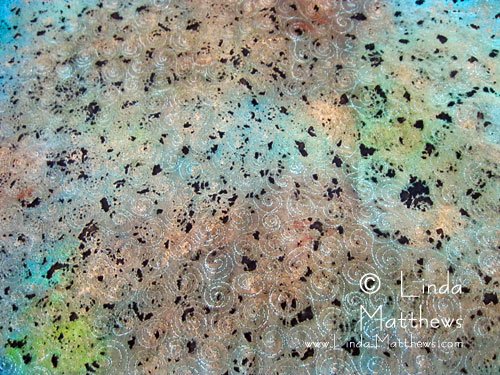
So I began with a project in mind – a small shoulder purse – and took a piece and painted it. I added an underlayer of fabric which will show through after I’ve heated the surface, and I’ve added some free motion stitching on top. The stitching acts as a resist and will help to contain the holes. It also adds some additional surface texture.

Lutradur

As I heated the lutradur with the heat gun, I noticed that the color changed. At first I was a little disappointed, but as I worked further I decided I really liked it.

Lutradur

After I was done heating, I added some gold highlights.

Lutradur

So now the fabric is ready and I like the way it’s turned out so far. The holes look a little different from the holes you get when you heat tyvek which turn the edges crunchy. The holes in lutradur are a little softer and more delicate in appearance.

I sort of have a plan for how I want this project to look when it’s finished. We’ll soon see how that turns out.

… Continue reading

Tyvek and It’s Many Uses

TyvekI was asked recently by a new art quilter “What is tyvek?” I guess for those of us who have worked with art quilts for any length of time, it’s easy to forget that there are new art quilters joining our ranks at any given time and I’m sure some of these newbies are scratching their heads over some of the products and techniques that are used for art quilting.

Weird and wonderful
Tyvek falls into one of those weird and wonderful “happy accident” categories where someone discovered that heating tyvek causes it to distort, wrinkle and rearrange itself into amazing shapes and textures – the perfect invitation for art quilters to begin exploring and experimenting with it.

It looks familiar
You have probably seen tyvek all over the place and never even realized it. Those white waterproof envelopes you throw away? … tyvek. That white insulation they use on new houses … tyvek. For other interesting uses for tyvek, visit the Materials Concept blog and be surprised.

Types
Tyvek comes in two different types;

  • a soft structure tyvek which is a soft fabric and is my personal favorite. The soft structure has a slightly textured surface.
  • and a hard structure tyvek which is much stiffer. The hard structure has a smooth surface.

Both types produce different results when heated.

Can it be sewn?
Of course! Tyvek can be needled easily by machine, but you will probably need to use a thimble when sewing by hand as the material can become quite thick and dense in places once it’s been heated which makes it a little difficult to get a hand needle through.

How do you use it?
For tyvek to contort you need to heat it. You can use a hot air gun (keep your fingers out of the way because it gets really hot) or you can iron it. It only takes a short burst of heat to see results, so begin gently.

But it’s white!
When you buy tyvek it’s white so it needs to be painted before you heat it and Lumiere metallic paints are my personal choice of paint and I think a favorite for lots of others. The paint seems to take on wonderful appearance once it’s been heated and you can see some the effects on these sample photos.

Heated with a hot air tool: underside and upperside

TyvekTyvek

Heated with an iron: underside and upperside

TyvekTyvek

There’s a section about working with tyvek included on my Titivations DVD but in the meantime here are some things you can do with it …

Beads (my favorites). I like to wrap the tyvek around some fabric before I heat it …

Tyvek

Tyvek

Tyvek

and backgrounds …

Tyvek

Tyvek

If you’re looking for tyvek to give it a try, you can find some here (no affiliation) …
Joggles.com
Friends Fabric Art

And if you try it out, send me some photos and I’ll post them online so everyone can see.

Still got questions? Leave a comment.

… Continue reading

From Scraps

Scraps

It’s amazing what you can do with scraps and leftovers. This little quilt (approx 18×12) was put together from samples and scraps leftover from a surface design workshop I recently taught.

Included in this sample is

  • tyvek (green squares in middle)
  • color washed brown paper (prairie points and leaves)
  • fabric paper with some cheesecloth attached (main pink square)

The color washed brown paper was fused onto some peltex and cut to shape. Then I added some machine wrapped cording around the edge of the prairie points to define them against the background.

Since the paper fabric looked very organic, I quilted organic type lines that look like flowing water and pebbles.

The tyvek was also fused to some peltex and cut to shape. I then handstitched the edges to finish them off.

Everything was layered onto a machine quilted background and the end result is very three dimensional. I have yet to add a few more embellishments (it’s not finished till it’s embellished!) and then it will be done.

All in all – a cute little art quilt.

… Continue reading