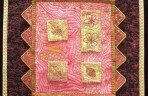
My top Ten Tips for Free Motion Machine Quilting

Looking for some “fabulous” free motion quilting tips?

Then look no further.

I don’t make many quilts any more, but I still do a lot of free motion – mostly free motion embroidery like this.

Free Motion Quilting

But I’ve been doing free motion for as long as I can remember (that’s a long time) and I know some of you struggle with it, so here are my Top Ten favorite tips for free motion ..

#1: the quilt sandwich

Before you begin machine quilting, you should ensure that your quilt is properly sandwiched and basted. Time taken for preparation beforehand will prevent problems occurring during the machine quilting process.

  • The backing and the batting should be at least 2" larger than the quilt top on all sides.
  • Press the top and the backing
  • Lay out the backing, wrong side up
  • Smooth out all the wrinkles
  • Lay out the batting on top of the backing and smooth out all the wrinkles
  • Center the quilt top, right side up, on top of the batting and smooth out all the wrinkles
  • Baste in place

Basting can be done using any of the following methods

basting spray
There are a variety of basting sprays available. For best results, follow the instructions on the can, and always ensure you’re in a well-ventilated area when using basting sprays.

safety pins
Quilter’s safety pins are slightly bent so that they are easy to remove as you’re sewing. Start pinning at one end of the quilt and work your way across and up, folding the quilt if necessary and ensuring that the quilt lays flat and wrinkle-free before you pin. Space the safety pins up to 6" apart.

hand stitching
Use a long darning needle to hand stitch and the process will go much quicker.

  • Baste close to the outer edge of the quilt first and then work across from one side to the other
  • If you’re right-handed, work right to left; if you’re left-handed, work left to right
  • Backstitch at the end of each row
  • Basting lines should be approx 6" apart
  • When you’re done basting across the quilt, rotate the quilt 45 deg and baste across the quilt in that direction also

Free Motion Quilting

#2: a good sewing or quilting machine

… Continue reading

Free Motion Quilting … Just Fabulous!

This week I’m sharing with you some of my favorite techniques. On Tuesday we looked at machine needle felting, yesterday was all about Titivating Embellishments and today we look at the wonderful world of free motion quilting Fabulous Free Motion Quilting.

Decorative free motion quilting is one of my very favorite techniques, probably my favorite. I’ve been doing free motion quilting, free motion embroidery, and thread painting for as long as I can ever remember, which is a very long time indeed.

I love the freedom of being able to sew beautiful, decorative patterns and designs onto cloth using all the beautiful colors and types of threads that are available today.

And not only on fabric paper, I also like to free motion on my fabric paper …

… Continue reading

My Favorite Techniques on DVD

Instructional DVDSI’m often asked if my instructional dvds are compatible for use in countries other than the US. The answer to that is…

Absolutely!

In fact my dvds are scattered all around the globe – the US of course, the UK, Australia and New Zealand, Europe, and Asia!

What’s Different About My DVDs?
For those not familiar with my dvds, they are actually presented a little differently to most other types of instructional dvds which usually contain only full length videos similar to what you find on a movie dvd. And it’s worth noting that I only use the dvd format because I always give you waaaayyyy too much information and it simply all won’t fit fit on a standard cd.

On each of my current series of dvds I share with you my very favorite techniques for each topic, and I give you dozens of different techniques on every dvd. In order to best present the information, each dvd contains multimedia content – a combination of video, images and pdf documents. To help you easily find what you’re looking for, this means that I have to use a different method of presenting the information than that used for traditional video dvds which doesn’t support pdf documents or jpeg images, and I do this by compiling the information in a pdf document and then I use an interactive menu with links – all created using Adobe Acrobat. (Adobe Acrobat has very advanced features to make your information look spectacular.)

For you, this means that the problems usually associated with playing dvds from other countries don’t exist because you use my dvds on your computer with Adobe Reader which uses a standard format regardless of what country you live in.

So How Do The DVDs Work?
When you first insert the dvd into your computer’s dvd player, this is what you see …

Instructional DVDS

It doesn’t look much like any pdf document you’ve every opened and is in fact an interactive menu and when you click on the links it takes you to similar looking pages with additional links to your pdf documents and images.

If you’d like a real-life demo, you can download one here. (Right click and save to your desktop) The demo is in a zipped file and is approx 7mb so for those of you with dial-up internet service it may take a while to download.

What’s included on the DVDs?

  • Video
    Each dvd contains a series of videos that are edited and narrated. I zoom the video in as close as possible so you get a good view of what’s going on. I then edit out all the boring stuff and then add voice over narration to clearly explain the technique, so the information you get with each short video is relevant and clearly explained. I do it like this so you don’t have to spend wasted time winding and rewinding a long length of video to find a particular scene. You simply click on the link to the technique you want to see and there it is.
  • Sample photos
    I provide LOTS of photos of my samples so you can close up how a particular result should look. I don’t hide anything and I’m not always perfect about doing things, just like you.
  • Printable Lessons
    Lessons are provided in pdf format so you can print them out and put them in your workbook. I always encourage students to keep a workbook for future reference.

For individual details of what’s included on each dvd please visit the store.

Let’s Have Some Fun
I now have four dvds (with more to come – probably next year) …

  • Felt-Punch-Embellish – An exploration of techniques and applications for using your needle felting machine.
  • Fabulous Free Motion Quilting – An exploration of techniques and applications for making your free motion quilting “FABULOUS!”.
  • Titivations – An exploration of techniques and applications for making your embellishments simply “titivating”.
  • Exploring Digital Grounds on Fabric – An exploration of techniques and applications for printing images on fabric using Golden Products Digital Grounds.

This week I thought it would be fun to visit each topic in turn and learn a little more about each. I’ll share some of my videos, some photos, some resources and links to other places on the web where you can find additional information. I’m passionate about what I do and I want you to be also!

So please join me tomorrow when we visit the wonderful world of Machine Needle Felting.

… Continue reading

Hand Dyed Fabric: All Done Playing with Complementary Colors

If you have been following the process:
It started here with some hand dyed fabrics; then I began the design process;
and now for the final results:

This was the result of the sample at the last installment:

Machine Embroidery

Now I needed to add a little green because what’s purple and yellow without green? So I added some small machine embroidered leaves around the edges of the stalk and stem to liven things up.

Machine Embroidery

Now for the edges. It would be really easy to simply bind off and finish it at that, but I wanted to give the piece a “soft edge” finish. As I had already used small circles as part of the flower design, I decided to use the circular design to finish the edges. I placed some water soluble stabilizer underneath along the edges (a great application for using up all those small scrappy pieces of stabilizer), then quilted a couple of rows of circles all around the edges – very organic looking.

Machine Embroidery

Then I carefully snipped away the fabric from the outer edges being careful not to cut into the stabilizer.

Machine Embroidery

Using an embroidery hoop to keep the stabilizer taught, I extended the circular stitching onto the stabilizer.

Machine Embroidery

Then I washed away the stabilizer leaving a soft lacy edge.

Machine Embroidery

The final touch was some hand beading to the central design;

Machine Embroidery

and some bead clusters along the edges.

Machine Embroidery

I then mounted the embroidery onto a quilted greenish colored hand-dyed background. The final size is 14″ x 21″. Considering the fabric that I started with, I’m really happy with the results.

Machine Embroidery

I still have a few pieces of hand dyed fabric left over, so I might use them up in a similar fashion over the next month or so.

… Continue reading

Hand Dyed Fabric: Playing with Complementary Colors

As the weather here in Florida turns nice and warm, I finally got the chance to go play in my dye room the other day. I’m currently working on a new quilt and wanted a very specific colored background fabric, so while I had everything set up in the dye room I also took the opportunity to spend a few extra hours “playing”.

Sidenote

Dyeing to QuiltAs a sidenote, some years ago I actually took the time to make a sample folder of dye recipes. This really is a time consuming process because you have to label everything and be very precise about mixing your dyes. However the samples have proved invaluable to me over the years particularly when I need a very specific color or combination of colors. With the dye recipe and sample right at your fingertips, it is extremely easy to reproduce the exact same color.

If you are interested in producing your own sample folder, I highly recommend the book Dyeing To Quilt : Quick, Direct Dye Methods for Quilt Makers by Joyce Mori and Cynthia Myerberg. While I have read a number of good dyeing books, I found this one particularly easy to read and understand, and very easy to follow. It also includes record sheets that you can copy and use to create your sample color runs.

Back to the story

I dyed it using a variegated range of complementary colors which I don’t work with very often, but gave me the perfect color I needed. After I was done I had lots of leftover dye which I never like to waste, so I decided to use it up.

I am very good at experimenting; in fact I love to do it. However when I know the outcome and the results are not good, I usually don’t want to go there again. And if you know anything of color theory, then you know that mixing complementary colors normally results in a “mud” color, usually (but not always) a good thing to avoid.

So here I had six fat quarters and various mixtures of complementary color dye. Will I or won’t I? Ok, let’s do it.

I pre-soaked the fat quarters in some soda ash. I figured they might have half a chance of turning into something useful if the colors took quickly. Then I squished them into a container one at a time, pouring different colors of leftover dye onto each piece as I squished it on top of the next. I was careful to try and not let the dye colors blend together too much, but a certain overlap was inevitable.

The resulting colors were not at all what I expected; the colors in the dye seemed to separate really quickly except for a few areas that turned a “light mud” and are not at all displeasing. The results in fact were a pleasant surprise so now I can’t wait to use the fabric on a project!

The moral of this story

Don’t ever be afraid to try; even if you think you know the outcome. The results just may surprise you.

Results

Hand Dyed Fabric

Hand Dyed Fabric

Hand Dyed Fabric

Hand Dyed Fabric

Hand Dyed Fabric

Hand Dyed Fabric

… Continue reading