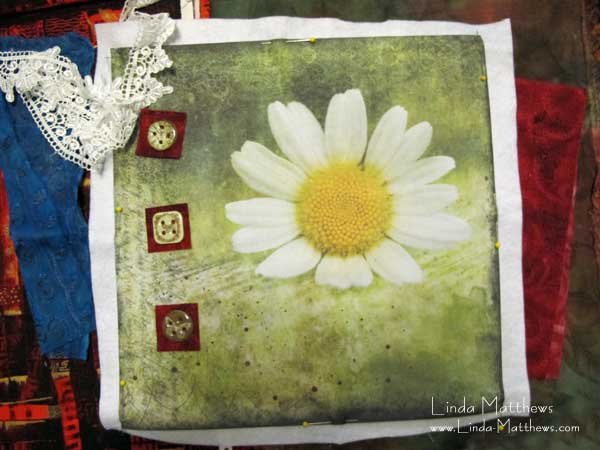
Need a quick weekend project? Try Some Fabric Beads

Next week I’m doing an embellishing workshop down in lovely Melbourne Florida for some lucky students, because next to printing on fabric, you all know how much I LOVE to embellish!

I know you can’t all be there with me, so here’s a little inspiration for you using one of my favorite methods for making fabric beads. This is a great way to use up all those small scraps of leftover fabric and fiber. And of course don’t forget – some of my favorite embellishing techniques are included on my Titivations DVDcheck the store for details.

Fabric Beads

Firstly, dress up your plain fabric using the decorative stitches on your sewing machine. I can’t tell you the number of times I hear students tell me they don’t use those decorative stitches but there are so many ways to use them! Tip ~ A little tear-away stabilizer underneath helps to support the fabric when you sew decorative stitches.

Fabric Beads

Cut your fabric into strips – my favorite size is about 1-1/2″ wide by about 2-3″ long – tapered to a point at one end.

Fabric Beads

Instead of decorative stitches, consider adding your own decorative designs using a Krylon Gold Leaf Pen or Elmer’s Metallic Painters Pen (available from craft stores). I love these pens and use them for all sorts of embellishment touch-ups.

Fabric Beads

On the right side of the fabric dab a bit of fabric glue to the squared off edge, and on the wrong side of the fabric add some fabric glue along the tapered edges. Then wrap the fabric around a piece of 1/4″ or 3/8″ dowel rod and press firmly to secure.

Fabric Beads

Fabric Beads

Once the glue has dried, embellish your fabric beads with bits of fiber or bead wraps (beads threaded onto some fine craft wire).

Fabric Beads

This is a great week-end project and you’ll have dozens of fabric beads in no time at all! Happy Friday and have fun!

… Continue reading

Video Tutorial: Moldable Foam Stamps

I was playing around the other day doing some fabric stamping using moldable foam stamp blocks. If you’ve never used these types of stamping blocks before, they are fun and easy to use. But best of all they’re reusable so you can use them again and again by impressing them with different types of designs.

This short video explains. (If you’re reading this post in an rss reader you may have to click through to the website to view the video.)

PS You can find various types of moldable foam stamp blocks at Dharma Trading – have fun!

… Continue reading

Lined Purse Strap Tutorial

Last month I posted a tutorial on how to make a simple purse strap; you can find it find it here. Today I’m going to share my new very favorite technique for making purse straps which is a lined purse strap. I think they just look so professional and elegant.

Lined Purse Strap

There is special interfacing available that makes it really easy to make lined purse straps called “Create-a-strap” Interfacing by Nancy Zieman, but buying this type of specialized stabilizer gets kind of expense when you make a lot of purse straps, so I’ve modified the idea, and this is how I do.

Note: This tutorial is for a 1″ finished width purse strap. You can adjust it to suit your needs.

Cut your main strap fabric and a piece of fusible interfacing at 2″ wide by the length of your strap.
Cut your strap lining fabric and a piece of fusible interfacing at 1.1/2″ wide by the length of your strap.
Fuse the interfacing to the fabric strips.

Lined Purse Strap

Using a hera marker or similar marking tool, and with the interfacing side facing up, make a mark 1/2″ from the edge on either side of the main strap, and 3/8″ from the edge on either side of the strap lining. You can see in the photo below right, how the hera marker makes visible creases.

Lined Purse Strap

Using some Stitch Witchery fusible tape, place a length of it down the center of the main strap. It’s a little difficult to see in the photo, but it’s there ;)

Lined Purse Strap

Fold over the creased edges of the strap and fuse in place with an iron. This is much easier than trying to pin it in place.

Lined Purse Strap

Fold the creased edges of the strap lining and pin in place down the center of the main strap. I don’t usually use the stitch witchery to fuse the strap lining; it doesn’t seem necessary.

Lined Purse Strap

Stitch the strap lining to the main strap close to the edge on each side. I like to use a stitch-in-the-ditch foot because it’s easy to keep the strap lining positioned properly.

Lined Purse Strap

And there it is, a beautifully lined purse strap! And so easy to make! Why didn’t I think of this before?

Lined Purse Strap

Printing on Sheer Fabric

ExtravorganzaI often get asked about printing on sheers and the best way to get sheer fabric through your printer.

When I first started experimenting with sheers I tried using Extravorganza which is available in stores and is sheets of organza cut to size and backed with a sheet of paper. This worked well enough for small print jobs, but when I tried to print a full size sheet I ran into trouble.

After printing my image and removing the backing paper I found that the fabric had been attached to the backing paper crooked so my resulting print had an extremely noticeable wavy edge on two sides that couldn’t be straightened without distorting the image and after trimming the edges straight, my design was considerably reduced in size and the effect I was looking for was lost.

So while I might recommend Extravorganza for the convenience of doing small prints, I certainly wouldn’t recommend it for anyone wanting to work with large prints, particularly since it is so expensive and there exists the risk of ending up with a lopsided print.

Printing on FabricSo I still had to find a way to print a large image onto a sheer fabric and as it turned out, it was an easy fix after all. I do a lot of inkjet printing on cotton fabric and have found that the best way to get it through my printer with 100% success every time is to adhere it to a full sheet size label. Freezer paper is ok but sometimes it slips and sometimes it doesn’t feed through properly. Full sheet size labels are guaranteed to get it through the printer each and every time – I’ve never had a misprint using label backings. And the best thing is that each sheet can be reused up to approximately 8-10 times if you’re careful.

So using full size labels as backing, I decided to try it with sheer organza using a little extra care to ensure the sides adhered straight. I stopped off at the fabric store and picked up a yard of white organza ($5.00 on sale – don’t you just love a bargain?). So now the challenge was not to repeat the mistakes of the past and to ensure that the fabric adhered to the backing straight on all sides.

First I cut a piece of organza slightly larger than the label.

Printing on Sheer Fabric

Then to ensure that the edges adhered straight on all sides, I frayed away the edges on two sides of the organza until I had two perfectly straight edges.

Printing on Sheer Fabric

Then I aligned the two straight edges with the lines on my cutting mat, and taped all four sides of the organza to the mat using masking tape. I then peeled the backing from the label and positioned it along the “straight” top and side edge and pressed it down firmly on all sides.

Printing on Sheer Fabric

Using a brayer I then pressed the label to the fabric to ensure it stuck properly all over and after removing the masking tape I turned it over and brayered from the fabric side to get rid of any bubbles.

Update: I use a brayer with a hard roller to ensure that the sticky label is stuck really well to the fabric.

Brayer

I then trimmed the edges of the fabric to size and could see that it was perfectly placed. Now for the moment of truth – printing out my design and it was a perfect print with perfectly straight edges – ahh success!! And although the backing paper ended up with a ghost image transfer it was still quite sticky and useful for additional print jobs so success all the way round.

Printing on Sheer Fabric

… Continue reading

Now You See It, Now You Don’t

NeedlelaceWith Valentines Day quickly approaching, I thought this would be an ideal time to revisit my tutorial for making a “see through” heart design using machine needle-lace.

Machine needle-lace is a very versatile technique and one I use often, particularly for making embellishments. But you can also use it for other applications and one of my favorites is “see-through” designs. This needle-lace heart design is a simple project that demonstrates this technique.

If you’re not familiar with machine needle-lace, it’s made using free motion and sewing small, pea-size loops which overlap themselves.

Needlelace

You will also need to use an embroidery hoop to help stabilize your fabric.

Needlelace

You can download this heart shaped template by right clicking on the image and saving to your desktop.

Needlelace

Generally you would use this technique on one or two layers of fabric, or a quilt block. Transfer your heart shaped design to the top of your fabric, hoop your fabric in an embroidery hoop, then stitch one or two rows of straight stitch around the design to stabilize the fabric.

Needlelace

Using small sharp scissors, cut away the center of the design close to the stitching line.

Needlelace

Cut a piece of water soluble stabilizer and pin the stabilizer in place underneath the cutaway design.

Needlelace

Fill in the design with machine needle-lace, then stitch a row of satin stitch to finish off the edge.

Needlelace

For added embellishment, you could also sew a row of decorative stitching around the outer edge of the design.

Needlelace

You could use this design as a quilt block or as a design element for a small project. Isn’t it pretty?

Needlelace

And of course, you’ll find even more inspiration for using this technique on my “Titivations” DVD. Visit the Instructional DVD Section of the store for details.

Titivations

… Continue reading